Bonds vs Fixed Deposits: Complete Comparison for Indian Investors
"Should I invest in bonds or stick with my bank FD?"
This is one of the most common questions we receive from Indian investors. And it makes perfect sense - Fixed Deposits have been the go-to safe investment for generations, while bonds are still relatively unfamiliar to most retail investors.
The truth? Both have their place in your portfolio. But understanding when to use which can significantly impact your wealth creation.
This comprehensive guide compares bonds and FDs across every important dimension - safety, returns, liquidity, taxation, and more - with real examples to help you make informed decisions.
Quick Comparison Table
Let's start with a bird's eye view:
| Feature | Fixed Deposits | Bonds |
|---|---|---|
| Issuer | Banks (public/private) | Government/Corporations |
| Interest Rate | 6.5-7.5% currently | 7-12% depending on type |
| Safety | Very high (DICGC insured up to ₹5L) | Varies (G-Secs safest) |
| Lock-in Period | None (premature penalty) | None (can sell in market) |
| Liquidity | Moderate (penalties apply) | Varies (good for G-Secs) |
| Interest Payment | Quarterly/Monthly/Annual | Usually semi-annual |
| Taxation | Interest fully taxed at slab | Interest at slab, LTCG 12.5% |
| Minimum Amount | ₹1,000-₹10,000 | ₹10,000 (G-Secs) |
| Premature Exit | Penalty (~0.5-1% rate cut) | Market price (may be ± face value) |
| Nomination | Yes | Yes |
| Senior Citizen Benefit | Extra 0.5% interest | No special benefit |
Now let's dive deep into each aspect.
Safety Comparison: Which is Safer?
Fixed Deposits: Very Safe, With Insurance
Safety Features:
- DICGC Insurance: Deposits up to ₹5 lakh per bank are insured by Deposit Insurance and Credit Guarantee Corporation
- Bank regulation: RBI-regulated, strict norms
- Historical track record: Very few bank failures in India
Risk Scenarios:
- If bank fails: You get up to ₹5 lakh back (per bank)
- If you have ₹10 lakh in one bank: ₹5 lakh is at risk
- If spread across 2 banks (₹5L each): Fully protected
Safety Rating: 9/10 for public sector banks, 8/10 for reputed private banks
Bonds: Varies by Issuer
Government Bonds (G-Secs):
- Safety: Highest possible (sovereign backing)
- Default risk: Virtually zero (Government of India has never defaulted)
- Insurance: Not needed - backed by government's taxing power
- Safety Rating: 10/10
State Development Loans (SDLs):
- Issued by state governments
- Very safe but slightly riskier than central government
- Safety Rating: 9/10
AAA-Rated Corporate Bonds:
- Highest corporate rating from CRISIL/ICRA
- Very low default risk but not zero
- Companies like HDFC, Bajaj Finance, LIC HF
- Safety Rating: 8/10
Lower-Rated Corporate Bonds (AA, A, BBB):
- Higher default risk
- Need careful evaluation
- Safety Rating: 5-7/10 depending on rating
Verdict: Safety
For amounts up to ₹5 lakh: FDs and G-Secs are equally safe
For amounts above ₹5 lakh:
- G-Secs are safer (no limit on safety)
- FDs need to be spread across banks
For highest possible safety: Government bonds (G-Secs)
Real Example: If you have ₹20 lakh to invest safely:
- FD route: Spread across 4 banks (₹5L each) for full insurance coverage
- Bond route: Put all in G-Secs without worrying about limits
Returns Comparison: Which Gives Higher Returns?
Current Interest Rates (December 2024)
Fixed Deposits:
- Public Sector Banks: 6.5-7% for general public
- Private Banks: 7-7.5%
- Small Finance Banks: 8-9%
- Senior Citizens: Additional 0.5% (7-8%)
Bonds:
- Treasury Bills (3-12 months): 6.5-7%
- Government Securities (5-10 years): 7-7.5%
- State Development Loans: 7.5-8%
- AAA Corporate Bonds: 8-9%
- AA/A Corporate Bonds: 9-11%
- Tax-Free Bonds: 5.5-6% (but tax-free!)
Real Return Examples
Scenario 1: ₹10,00,000 for 5 Years
Option A: Bank FD at 7%
- Annual interest: ₹70,000
- 5-year total interest: ₹3,50,000*
- Maturity value: ~₹13,50,000
Option B: G-Sec at 7.3%
- Annual interest: ₹73,000
- 5-year total interest: ₹3,65,000
- Maturity value: ₹13,65,000
Extra earning from G-Sec: ₹15,000
*Assuming simple interest for easy comparison; actual FD compounds quarterly
Scenario 2: ₹5,00,000 for 3 Years
Option A: Small Finance Bank FD at 8.5%
- Maturity value: ~₹6,38,000
- Interest earned: ₹1,38,000
Option B: AAA Corporate Bond at 8.8%
- Interest earned: ₹1,32,000 (semi-annual)
- Plus potential capital appreciation if sold early
Winner: FD (by ₹6,000) but very close
Compound Interest Advantage: FDs
FDs compound (quarterly for most banks):
- Your interest earns interest
- Effective yield is higher than stated rate
- 7% FD compounded quarterly = ~7.19% effective yield
Bonds pay simple interest:
- You receive interest semi-annually
- Unless you reinvest, no compounding
- 7.2% coupon = 7.2% yield (if held to maturity)
However: You can manually reinvest bond interest to create compounding
Verdict: Returns
For general public: Bonds typically offer 0.3-0.8% higher returns
For senior citizens: FDs competitive due to extra 0.5% benefit
For highest returns: AAA/AA rated corporate bonds (8-10%) beat all FD options
Risk-adjusted: G-Secs offer best returns for zero-risk investments
Liquidity Comparison: Accessing Your Money
Fixed Deposits: Breakable, But With Penalty
Premature Withdrawal:
- Allowed: Yes, for most FDs (except tax-saving FDs)
- Penalty: Usually 0.5-1% reduction in interest rate
- Time: 1-2 working days to get money
Example:
- FD rate: 7% for 5 years
- Premature withdrawal after 2 years
- Penalty: Interest reduced to 6% (from 7%)
- You lose: 1% × 2 years on your principal
Tax-Saving FDs:
- Lock-in: 5 years mandatory
- No premature withdrawal allowed
Bonds: Sellable in Secondary Market
Government Bonds:
- Can be sold anytime in secondary market (NDS-OM platform)
- Price risk: You might get more or less than face value
- Settlement: T+1 day
- Liquidity: Good (actively traded)
Corporate Bonds:
- Can be sold if listed on exchanges
- Liquidity: Varies (popular bonds trade easily)
- Unlisted bonds: Difficult to sell
Price Fluctuation:
Unlike FDs, bond prices change with interest rates:
If interest rates rise: Your bond's market value falls If interest rates fall: Your bond's market value rises
Example:
- You bought ₹10,00,000 G-Sec at 7% yield
- After 1 year, new G-Secs offer 8% (rates increased)
- Your bond's market value: ~₹9,50,000 (loss if you sell)
- But: Hold till maturity, still get full ₹10,00,000 back
Verdict: Liquidity
For guaranteed liquidity: FDs (known penalty, predictable loss)
For flexible liquidity: Government bonds (can sell easily, but price varies)
For emergency funds: FDs preferred (no principal loss risk)
For planned investments: Bonds work well (hold till maturity)
Key Insight: FDs guarantee your principal (minus predictable penalty). Bonds don't guarantee market price, but guarantee face value at maturity.
Taxation Comparison: What You Actually Keep
Taxation makes a HUGE difference in actual returns. Let's break it down.
Fixed Deposit Taxation
Interest Income:
- Fully taxable at your income tax slab rate
- Added to "Income from Other Sources"
- TDS: 10% if interest > ₹40,000/year (₹50,000 for senior citizens)
No Capital Gains: FDs don't have capital gains
Example (30% tax bracket):
- FD rate: 7%
- Tax on interest: 30%
- Post-tax return: 7% × (1 - 0.30) = 4.9%
Bond Taxation
Interest Income:
- Taxable at slab rate (like FDs)
- No TDS on G-Secs
- 10% TDS on corporate bonds (if interest > ₹5,000)
Capital Gains (if sold before maturity):
- Short-term (less than 12 months): Taxed at slab rate
- Long-term (more than 12 months): 12.5% flat tax
Tax-Free Bonds:
- Interest is 100% tax-free
- Available from NHAI, IRFC, etc.
- Yields: 5.5-6%
Post-Tax Return Comparison
₹10,00,000 Investment, 5 Years, 30% Tax Bracket
| Investment | Gross Yield | Post-Tax Yield | 5-Year Earnings |
|---|---|---|---|
| Bank FD | 7% | 4.9% | ₹2,45,000 |
| G-Sec | 7.2% | 5.04% | ₹2,52,000 |
| Corporate Bond (AAA) | 8.5% | 5.95% | ₹2,97,500 |
| Tax-Free Bond | 5.5% | 5.5% | ₹2,75,000 |
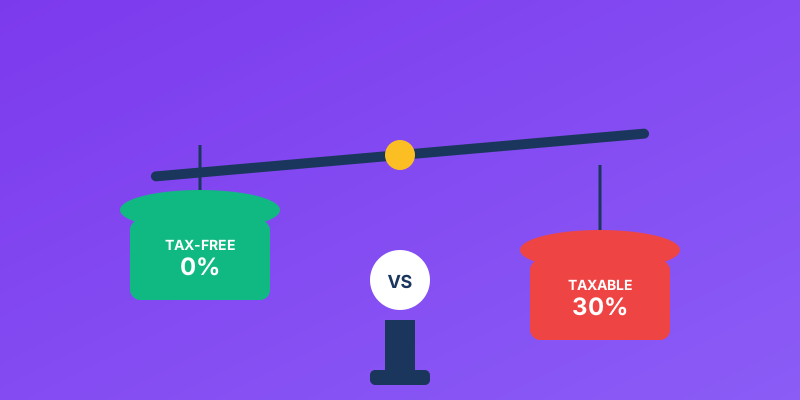
Surprise winner: Tax-free bond at just 5.5% gross beats 7% FD post-tax!
Reason: 5.5% tax-free = 7.86% taxable equivalent for 30% bracket
Calculation:
Tax-Free Yield ÷ (1 - Tax Rate) = Equivalent Taxable Yield
5.5% ÷ (1 - 0.30) = 7.86%
Verdict: Taxation
20-30% tax bracket: Tax-free bonds offer best post-tax returns
10% tax bracket: Bonds and FDs are similar post-tax
Nil/5% tax bracket: Highest yielding taxable option wins (corporate bonds)
For capital gains tax benefit: Bonds offer 12.5% LTCG vs 30% slab rate
Flexibility and Features Comparison
Interest Payment Frequency
Fixed Deposits:
- Monthly (for regular income seekers)
- Quarterly
- Annual
- Cumulative (at maturity)
Bonds:
- Typically semi-annual (every 6 months)
- T-Bills: At maturity (zero-coupon)
- Less flexible than FDs
Winner for monthly income: FDs
Loan Against Security
FDs:
- Can get loan against FD easily
- Interest rate: FD rate + 1-2%
- No FD breakage needed
- Available at the same bank
Bonds:
- Loan against bonds available but less common
- Banks may offer 50-80% of bond value
- Corporate bonds easier than G-Secs
- Rates vary
Winner: FDs (easier, better rates)
Senior Citizen Benefits
FDs:
- Extra 0.5% interest rate for senior citizens
- 7% becomes 7.5%
- Available across all banks
- Senior Citizen Savings Scheme: Up to 8.2% (5-year lock-in)
Bonds:
- No special rates for senior citizens
- Same rates for everyone
Winner: FDs for seniors
Nomination Facility
Both FDs and Bonds allow nomination - tie here.
Auto-Renewal
FDs:
- Can set auto-renewal at maturity
- No action needed
- Continues at prevailing rates
Bonds:
- No auto-renewal
- Bond matures, principal credited
- You must reinvest manually
Winner: FDs (convenience)
Investment Amount Flexibility
Minimum Investment
FDs:
- As low as ₹1,000 in most banks
- ₹5,000-₹10,000 for better rates
Bonds:
- RBI Retail Direct: ₹10,000 minimum
- Corporate bonds: ₹10,000-₹10,00,000 depending on issuer
Winner: FDs (lower minimum)
Maximum Investment
FDs:
- No limit
- But only ₹5 lakh per bank is insured
Bonds:
- Primary auction: Up to ₹2 crore for retail investors
- No effective limit on safety (for G-Secs)
Winner: Bonds (for large amounts seeking safety)
Diversification Comparison
Fixed Deposits
Limited diversification:
- Can choose different banks
- Can vary tenures
- Interest rates similar across banks
Types:
- Regular FDs
- Tax-saving FDs (5-year lock-in)
- Senior Citizen FDs
Bonds
Extensive diversification:
- Government vs Corporate
- Different maturities (3 months to 30 years)
- Different credit ratings (AAA to BBB)
- Different sectors (infrastructure, finance, manufacturing)
- Tax-free bonds
- Sovereign Gold Bonds
Types:
- Treasury Bills (3-12 months)
- Government Securities (2-40 years)
- State Development Loans
- Corporate Bonds (varied ratings)
- Tax-Free Bonds
- Sovereign Gold Bonds (linked to gold price)
Winner: Bonds (much more variety)
When to Choose Fixed Deposits
FDs are the right choice when:
1. You're a First-Time Investor
- Simple to understand: Fixed rate, fixed tenure, predictable returns
- No market risk: Principal guaranteed
- Easy to open: Any bank branch
- Familiar: Most Indians already have FDs
2. You Need Emergency Funds
- Predictable penalty: Know exactly what you'll lose
- Quick access: Break FD, get money in 1-2 days
- No price fluctuation: ₹5 lakh invested = minimum ₹4.95 lakh accessible
Emergency Fund Strategy:
- Keep 3 months' expenses in savings account
- Keep 3-6 months in FD (for 1% extra vs savings)
3. You Want Regular Monthly Income
- Monthly interest option available
- Perfect for retirees
- Easier than semi-annual bond interest
Example: ₹20 lakh FD at 7% monthly interest = ₹11,667/month
4. Short-Term Goals (1-3 Years)
- Lock in rates: Fixed for the tenure
- No interest rate risk: Unlike bonds
- Predictable maturity value: Plan exactly
Use Cases:
- Down payment for house (2-year FD)
- Child's school admission (1-year FD)
- Car purchase (18-month FD)
5. You're a Senior Citizen
- Extra 0.5% interest benefit
- SCSS offers 8.2% (5-year tenure)
- Monthly income options
- Simple management: No secondary market complexity
6. Small Investment Amounts
- Can start with ₹1,000
- No account opening needed (use existing bank account)
- Better than keeping in savings account (3-4% vs 7%)
7. You're in Low Tax Bracket (0-5%)
- Taxation disadvantage of FDs is minimal
- Post-tax FD returns comparable to post-tax bond returns
- Simpler tax filing
When to Choose Bonds
Bonds are the better choice when:
1. You're in High Tax Bracket (20-30%)
Tax-free bonds are game-changers:
- 5.5% tax-free = 7.86% taxable equivalent (30% bracket)
- Beats all FD options post-tax
- Simple tax filing (no reporting needed)
Example (30% bracket, ₹10 lakh):
- FD at 7%: Post-tax ₹49,000/year
- Tax-free bond at 5.5%: ₹55,000/year
- Extra earnings: ₹6,000/year
2. Large Investment Amounts (>₹5 Lakh)
Problem with FDs: Only ₹5 lakh insured per bank
Solution with Bonds:
- ₹50 lakh in G-Secs = 100% safe (sovereign guarantee)
- No need to open accounts in multiple banks
- Single platform (RBI Retail Direct)
3. You Want Higher Returns
- AAA corporate bonds: 8-9% (vs 7% FDs)
- Slightly lower-rated bonds: 9-11%
- Extra 1-2% on large amounts adds up
Example (₹20 lakh, 5 years):
- FD at 7%: ₹7,00,000 interest
- AAA bond at 8.5%: ₹8,50,000 interest
- Extra earnings: ₹1,50,000
4. Long-Term Goals (5+ Years)
- Better returns compound over time
- Capital gains tax benefit (12.5% LTCG)
- Can ride out market fluctuations
Use Cases:
- Retirement (15-20 year bonds)
- Child's college fund (10-15 year bonds)
- Wealth preservation (long-term G-Secs)
5. You Want Diversification
Building a balanced portfolio:
- 40% stocks (growth)
- 40% bonds (stability + better returns than FD)
- 20% FD/liquid funds (emergency)
Why bonds over FDs: Higher returns in the "stability" portion
6. You Can Handle Market Fluctuations
- Bond prices fluctuate in secondary market
- If you won't panic sell, you can handle bonds
- Hold till maturity = get face value regardless of interim price
Investor Profile:
- Understanding of interest rate movements
- Willingness to hold till maturity
- No panic about daily price changes
7. You Want Variety
Create a bond ladder:
- ₹2L in 1-year T-Bill
- ₹3L in 3-year G-Sec
- ₹3L in 5-year SDL
- ₹2L in 10-year G-Sec
Benefits:
- Staggered maturity
- Average out interest rate changes
- Liquidity at regular intervals
8. You're Building Retirement Income
Bonds offer:
- Predictable semi-annual income
- Long-term safety (G-Secs)
- Tax-free options (reduce tax in retirement)
- Can match bond maturity with retirement age
Example Strategy (Age 50, retiring at 60):
- Buy 10-year G-Secs
- Matures exactly when you retire
- Guaranteed income for 10 years
- Reinvest at retirement for regular income
The Hybrid Strategy: Use Both!
Why choose when you can have both?
Balanced Portfolio Example (₹20 Lakhs)
Emergency Layer (₹5 lakhs):
- ₹2L in savings account (immediate access)
- ₹3L in 1-year FD (can break if needed)
Stable Income Layer (₹8 lakhs):
- ₹5L in G-Secs (5-year)
- ₹3L in tax-free bonds (if in high tax bracket)
Higher Return Layer (₹7 lakhs):
- ₹4L in AAA corporate bonds
- ₹3L in 3-year bank FD (guaranteed rates)
Benefits:
- Safety (FD + G-Sec)
- Returns (corporate bonds)
- Tax efficiency (tax-free bonds)
- Liquidity (FD + short-term T-Bills)
Age-Based Strategy
Age 25-35 (Wealth Building):
- 20% in FDs (emergency)
- 30% in bonds (stability)
- 50% in equity (growth)
Age 35-50 (Wealth Accumulation):
- 25% in FDs (emergency + short-term goals)
- 35% in bonds (better returns than FD)
- 40% in equity (moderate growth)
Age 50-60 (Pre-Retirement):
- 30% in FDs (safety + liquidity)
- 50% in bonds (G-Secs + tax-free)
- 20% in equity (limited exposure)
Age 60+ (Retirement):
- 40% in FDs (monthly income + safety)
- 50% in G-Secs/tax-free bonds (stability)
- 10% in equity (inflation protection)
Real-Life Case Studies
Case 1: Rajesh, 32, Software Engineer (₹15L Salary)
Goal: Build emergency fund + start investing
Best Strategy:
- ₹3L in FD (emergency fund - can break if needed)
- ₹5L in G-Secs via RBI Retail Direct (better returns, sovereign safety)
- ₹2L in AAA corporate bonds (learn bond investing)
Why not all FD: Higher tax bracket (30%) - bonds offer better post-tax returns
Why some FD: Emergency liquidity with predictable penalty
Case 2: Sunita, 62, Retired Teacher (₹4L Pension)
Goal: Regular monthly income, safety
Best Strategy:
- ₹10L in Senior Citizen Savings Scheme at 8.2% (5-year)
- ₹10L in bank FD with monthly interest at 7.5% (senior citizen rate)
- ₹5L in G-Secs (5-year) for diversification
Why mostly FD:
- Senior citizen benefit (extra 0.5%)
- Monthly income option
- Simplicity
- Low tax bracket (pension + interest below 10L)
Why some G-Sec: Diversification, better returns on portion not needing monthly income
Case 3: Priya, 28, First-Time Investor (₹8L Salary)
Goal: Save for down payment in 3 years
Best Strategy:
- ₹6L in 3-year FD at 7.5% (predictable maturity value)
- ₹2L in 364-day T-Bills (rollover yearly) (learn bonds)
- ₹2L in equity mutual funds (growth component)
Why mostly FD:
- Short-term goal (3 years)
- Need predictable amount
- First-time investor (simplicity)
Why some T-Bills: Learn bond investing with short-term, simple product
The Verdict: Which is Better?
There's no universal answer - it depends on:
| Choose FDs if... | Choose Bonds if... |
|---|---|
| First-time investor | Comfortable with investing |
| Need monthly income | OK with semi-annual income |
| Senior citizen | In high tax bracket (20-30%) |
| Emergency funds | Long-term goals (5+ years) |
| Short-term goals (1-3 years) | Want higher returns |
| Low tax bracket (0-10%) | Large amounts (>₹5L) |
| Want simplicity | Want diversification |
| Small amounts (under ₹50,000) | Willing to learn |
Best Approach: Use both strategically
- FDs for: Emergency, short-term, monthly income, simplicity
- Bonds for: Higher returns, long-term, tax efficiency, large amounts
Action Steps
If You Currently Only Have FDs:
- Keep some FDs for emergency (3-6 months' expenses)
- Open RBI Retail Direct account (free)
- Start small: ₹10,000 in T-Bill or G-Sec
- Experience the difference: Interest payment, liquidity, returns
- Gradually shift long-term money from FDs to bonds
If You're Starting Fresh:
- Build emergency FD first (3-6 months' expenses)
- Learn about bonds (you're already doing this!)
- Split future investments: Some FD, some bonds
- Rebalance annually: Adjust based on goals and learning
Final Thoughts
Fixed Deposits and Bonds are both valuable tools - knowing when to use each is the key to smart investing.
FDs shine in:
- Simplicity and familiarity
- Predictable returns
- Emergency access
- Senior citizen benefits
Bonds excel in:
- Higher returns
- Tax efficiency
- Diversification
- Large-amount safety
Your perfect strategy likely involves both. Start with what you're comfortable with, learn gradually, and build a diversified fixed-income portfolio that combines the best of both worlds.
Next Steps:
- Use our FD vs Bond Calculator to compare post-tax returns for your specific situation
- Read our RBI Retail Direct guide to start investing in bonds
- Check our Bond Tax Guide to understand tax implications
Remember: The best investment is one that helps you sleep peacefully at night while growing your wealth steadily. Whether that's FDs, bonds, or a mix of both, make an informed choice based on your unique situation.
Disclaimer: This comparison is for educational purposes only. Interest rates and features mentioned are indicative as of December 2024. Please verify current rates and consult a financial advisor before making investment decisions.