Getting Started with Bonds: A Beginner's Guide for Indian Investors
If you've only known Fixed Deposits (FDs) as your go-to safe investment option, you're not alone. Most Indian retail investors are familiar with FDs but surprisingly unfamiliar with bonds - despite bonds being one of the most fundamental investment instruments globally.
This comprehensive guide will walk you through everything you need to know to get started with bond investing in India.
What Are Bonds? The Simple Explanation
Think of a bond as a formal IOU - a loan agreement between you (the investor) and a borrower (the bond issuer).
Here's a simple analogy: When you buy a bond, you're essentially lending money to the issuer - which could be the Government of India, a state government, or a company. In return, they promise to:
- Pay you regular interest (called "coupon payments") - usually every 6 months
- Return your principal amount (called "face value") when the bond matures
Example: You buy a ₹10,00,000 Government of India bond with an 8% annual coupon rate and 5-year maturity.
- What you get: ₹40,000 every 6 months (₹80,000 per year) as interest
- What happens at maturity: After 5 years, you get back your ₹10,00,000 principal
- Total earnings: ₹4,00,000 in interest over 5 years
Unlike stocks where returns are uncertain, bonds offer predictable income - which is why they're called "fixed income" securities.
Why Should You Invest in Bonds?
1. Stability and Predictability
Bonds provide regular, predictable income. You know exactly how much you'll receive and when. This makes them excellent for:
- Retirees seeking steady income
- Conservative investors prioritizing capital preservation
- Planning for specific future expenses
2. Diversification
The golden rule of investing is "don't put all your eggs in one basket." Bonds typically move differently than stocks. When stock markets fall, high-quality bonds often hold their value or even increase, providing a cushion to your portfolio.
3. Better Returns Than Traditional Options
While bonds are stable like FDs, they often offer:
- Higher yields: Government bonds currently offer 7-7.5%, while many bank FDs offer 6.5-7%
- Liquidity: Listed bonds can be sold before maturity (though prices fluctuate)
- Variety: Choose from different maturities, issuers, and risk levels
4. Support Your Country
When you buy Government bonds, you're directly lending to the nation and supporting infrastructure development, education, and healthcare initiatives.
Key Terms Every Bond Investor Must Know
Face Value (Par Value)
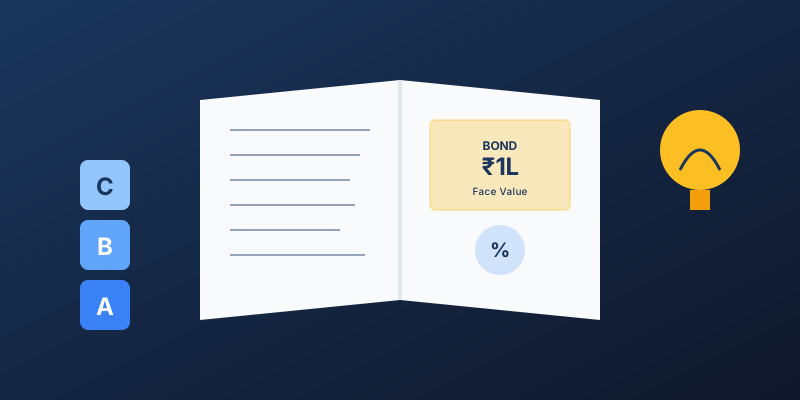
The principal amount of the bond - what you'll get back at maturity. Most bonds in India have a face value of ₹1,000 or ₹10,00,000.
Coupon Rate
The annual interest rate the bond pays, expressed as a percentage of face value.
Example: A bond with ₹1,00,000 face value and 8% coupon pays ₹8,000 per year (usually ₹4,000 every 6 months).
Maturity Date
The date when the bond expires and the issuer repays the face value. Bonds can have maturity periods ranging from a few months (Treasury Bills) to 30+ years (long-term Government bonds).
Yield
This is where it gets interesting. Yield is the actual return you earn on a bond, which can differ from the coupon rate.
Why? Because bond prices fluctuate in the secondary market.
Simple Example:
- Original bond price: ₹1,000 (face value)
- Coupon rate: 8% (₹80 per year)
- Current market price: ₹950
Your yield isn't 8% - it's actually higher because you're paying less than face value. The yield to maturity (YTM) would be approximately 9.2%.
Credit Rating
A grade (like AAA, AA, BBB) given by rating agencies (CRISIL, ICRA, CARE) that indicates how likely the issuer is to repay. Higher ratings mean lower risk but usually lower returns.
Government of India bonds are considered the safest (rated SOVEREIGN).
Accrued Interest
When you buy a bond between coupon payment dates, you pay the seller for the interest that has accumulated since the last payment. Don't worry - you'll get it back at the next coupon date!
Types of Bonds Available in India
1. Government Securities (G-Secs)
Issued by the Central Government. These are the safest bonds in India with virtually zero default risk.
- Typical tenure: 5 to 40 years
- Current yields: 7-7.5% per annum
- Minimum investment: ₹10,000 (via RBI Retail Direct)
2. Treasury Bills (T-Bills)
Short-term government securities with maturity of less than 1 year.
- Tenures: 91 days, 182 days, 364 days
- Current yields: 6.5-7% per annum
- How they work: Sold at a discount, redeemed at face value
Example: Buy a 91-day T-Bill worth ₹100 face value for ₹98.25. After 91 days, get ₹100 back. Your profit of ₹1.75 is your interest.
3. State Development Loans (SDLs)
Issued by state governments. Slightly higher risk than G-Secs but still very safe.
- Yields: Usually 0.25-0.75% higher than G-Secs
- Backed by: State government's taxing power
4. Corporate Bonds
Issued by companies to raise funds.
- Risk: Varies based on company's financial health
- Yields: 8-12% depending on credit rating
- Liquidity: Often lower than government bonds
5. Tax-Free Bonds
Issued by government entities (NHAI, IRFC, etc.). Interest earned is completely tax-free.
- Yields: Currently 5.5-6% (tax-free!)
- Who should buy: High income tax bracket investors
- Availability: Limited issuance; sold out quickly
6. Sovereign Gold Bonds (SGBs)
Government securities denominated in gold. You get both gold price appreciation and 2.5% annual interest.
How Do Bonds Compare to Fixed Deposits?
| Feature | Bonds | Fixed Deposits |
|---|---|---|
| Issuer | Government/Companies | Banks |
| Safety | Varies; G-Secs are safest | Very safe (insured up to ₹5 lakh) |
| Returns | 7-12% depending on type | 6.5-7.5% |
| Lock-in | Can sell in secondary market | Penalty for premature withdrawal |
| Interest | Usually semi-annual | Quarterly/annual |
| Taxation | Interest taxed at slab; LTCG at 12.5% | Interest fully taxed at slab rate |
| Minimum Amount | ₹10,000 for G-Secs | ₹1,000 - ₹10,000 |
Key Difference: Bond prices fluctuate. If you sell before maturity, you might get more or less than your purchase price. FD principal is locked in.
Your First Steps to Start Bond Investing
Step 1: Understand Your Investment Goals
Ask yourself:
- How long can you invest? (Choose bond maturity accordingly)
- What's your risk tolerance? (Start with G-Secs if conservative)
- Do you need regular income? (Choose coupon bonds over zero-coupon)
- What's your tax bracket? (High bracket? Consider tax-free bonds)
Step 2: Open the Right Account
For Government Bonds:
- Open an RBI Retail Direct account (free, online)
- Directly buy G-Secs and T-Bills with no brokerage
For Corporate Bonds:
- Open a Demat account with any broker
- Access both primary issuances and secondary market
Step 3: Start Small and Safe
For your first bond investment:
- Start with: ₹10,000-₹50,000
- Choose: Government Securities (G-Secs or T-Bills)
- Platform: RBI Retail Direct
- Tenure: 2-5 years for moderate liquidity needs
Step 4: Understand the Costs
Government Bonds via RBI Retail Direct:
- Zero brokerage fees
- Zero account maintenance charges
Corporate Bonds:
- Brokerage: 0.1-0.5% typically
- Demat charges: ₹300-₹750 annually
Step 5: Monitor and Diversify
Once comfortable:
- Add different maturity bonds (laddering strategy)
- Mix government and high-rated corporate bonds
- Rebalance based on changing interest rate scenarios
Common Mistakes to Avoid
1. Chasing High Yields Blindly
A 12% corporate bond from an unknown company is tempting, but ask why it's offering so much more than a 7% G-Sec. Higher yield = higher risk.
Tip: For beginners, stick to AAA or AA+ rated bonds.
2. Ignoring Interest Rate Risk
Bond prices and interest rates move inversely. If rates rise, your bond's market value falls (though you still get face value at maturity).
Solution: Don't invest emergency funds in long-term bonds.
3. Not Considering Taxes
That 9% corporate bond might give you only 6.2% post-tax if you're in the 30% tax bracket.
Better approach: Calculate post-tax returns before investing.
4. Putting All Money in One Bond
Diversify across:
- Different issuers
- Different maturity dates
- Government and corporate bonds
Real Example: Your First Bond Investment
Let's say you have ₹2,00,000 to invest and want to start with bonds.
Conservative Approach:
- ₹1,00,000 in a 5-year G-Sec at 7.2% → Earn ₹7,200/year
- ₹50,000 in a 2-year G-Sec at 6.8% → Earn ₹3,400/year
- ₹50,000 in 91-day T-Bills → Flexibility for short-term needs
Total annual income: ~₹10,600 with complete safety
Moderate Approach:
- ₹1,00,000 in G-Secs at 7.2%
- ₹1,00,000 in AAA-rated corporate bond at 8.5%
Total annual income: ~₹15,700 with minimal additional risk
What You Should Know About Bond Liquidity
Unlike FDs where you're locked in (with penalties), listed bonds can be sold anytime in the secondary market. However:
- Government bonds: Good liquidity, easy to sell
- Popular corporate bonds: Moderate liquidity
- Unlisted corporate bonds: Poor liquidity, hard to sell
Key Takeaway: If you might need the money before maturity, stick to liquid government bonds or keep bond tenure short.
Next Steps: Continue Your Bond Education
Now that you understand the basics:
- Learn about RBI Retail Direct: Read our detailed guide on opening an account and making your first purchase
- Understand taxation: Know how bond income is taxed (use our bond taxation guide)
- Calculate returns: Use our YTM calculator to compare different bonds
- Track rates: Follow RBI announcements on policy rates - they affect bond yields
Final Thoughts
Bonds are not complicated - they're actually simpler and more predictable than stocks. The key is to start small, understand what you're buying, and match bonds to your financial goals.
Remember:
- For safety: Choose Government bonds
- For higher returns: Consider AAA-rated corporate bonds
- For tax savings: Look at tax-free bonds when available
- For diversification: Mix different types and maturities
The bond market in India has opened up significantly with RBI Retail Direct, making it easier than ever for retail investors to access these instruments. There's never been a better time to add bonds to your investment portfolio.
Ready to start? Open your RBI Retail Direct account today and buy your first Government Security. Start with just ₹10,000 and experience the stability and predictability of bond investing.
Disclaimer: This article is for educational purposes only. Please consult with a financial advisor before making investment decisions. Bond yields and tax rates mentioned are indicative and may change.